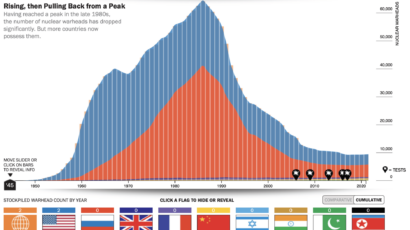
A sampling of what's available...

Nuclear pursuits, 2012

By Robert S. Norris, Hans M. Kristensen
Portraits of Kim Il-sung and Kim Jong-il hang at the airport in Pyongyang. A spot remains for Kim Jong-sun.

North Korea from 30,000 feet

Niko Milonopoulos, Siegfried S. Hecker, and Robert Carlin

In the January/February issue of the Bulletin, Siegfried S. Hecker and Robert Carlin assessed North Korea's nuclear developments in 2011. That assessment preceded the death of Kim Jong-il on December 17. This article supplements the Hecker/Carlin piece, analyzing leadership change and possible future trajectories of North Korea's nuclear program.

  • Nuclear weapons 2011: Momentum slows, reality returns

    By Steven E. Miller

    In the Doomsday Clock issue of the Bulletin, the author takes a look at five events that unfolded in 2011 and that seem certain to cast a powerful shadow in months and years to come. No new breakthroughs occurred, the author writes, adding that 2012 could be a much more difficult year.

  • New START: One year later
    By Kingston Reif

    With the anniversary of New START's entry into force, it's time for an examination of the treaty's successes, future opportunities, and the hurdles nuclear arms reductions still face.

  • How to prevent war with Iran
    By Joshua Pollack

    As Israel attempts to disrupt Iran's nuclear ambitions and the United States enforces sanctions against the state, Iran calls for revenge. What needs to be done to avert war? Steps Israel, the United States, and Iran should -- and should not -- take.

Aritst Charles Krafft's "Biological Warfare Canisters" displayed at the Andipa Gallery in London in June 2008.

Biosecurity in 2011: Not a year to change minds

Gerald L. Epstein

In the Doomsday Clock issue, the author writes that the central questions for biosecurity in 2012 will focus on the international community's ability to cooperate and whether it can think creatively and strategically and agree to enter partnerships with scientists from all regions of the world.

  • Going viral
    By Laura Kahn

    Scientists recently made the deadly H5N1 influenza virus more communicable. Clearly it's time for the National Institutes of Health to have greater oversight before it funds one of the seven deadly sins of biomedical research.

Steam rises from the cooling pond outside International Power Plc's Hazelwood coal-fired power station in Australia.

Climate change 2011: A status report on US policy

Steven Cohen and Alison Miller

In the Doomsday Clock issue of the Bulletin, the authors write that a growing partisan divide in Congress stalled almost all new federal climate policy in 2011.

The crippled Fukushima Daiichi Nuclear Power Station on November 12, 2011.

Nuclear energy 2011: A watershed year

Mark Hibbs

In the Doomsday Clock issue of the Bulletin, the author reviews reassessments undertaken around the world after the 2011 accident in Japan and underlines Europe's critical role in whether the future of nuclear energy will be global.

Web Edition

Columnists

  • Laura H. KahnProfile

    The science fiction effect

    From Frankenstein to Jurassic Park, authors have been writing about "mad scientists" messing around with life. Science fiction can be a powerful tool to influence society's views of the life sciences -- one scientists should take advantage of.

  • Kingston ReifProfile

    New START: One year later

    With the anniversary of New START's entry into force, it's time for an examination of the treaty's successes, future opportunities, and the hurdles nuclear arms reductions still face.

  • Hugh GustersonProfile

    An education in occupation

    Iraq's once great universities are in ruins -- thanks to the United States.

  • Joshua PollackProfile

    How to prevent war with Iran

    As Israel attempts to disrupt Iran's nuclear ambitions and the United States enforces sanctions against the state, Iran calls for revenge. What needs to be done to avert war? Steps Israel, the United States, and Iran should -- and should not -- take.

  • Fissile Materials Working GroupProfile

    Involuntary response

    The second Nuclear Security Summit needs a real plan to secure nuclear materials worldwide -- rather than relying on voluntary efforts and nonbinding, unchecked agreements.

View All

Analysis

  • America's nuclear future: Does the public have a fair say in it?

    By Seth P. Tuler, Eugene A. Rosa, and Thomas Webler

    Did the Blue Ribbon Commission on America's Nuclear Future provide sufficient opportunities for public engagement? Three experts on participatory processes say the Commission fell short.

  • A hinge moment for the BWC?

    By Kirk C. Bansak

    The future of biological weapons control may depend on six countries -- China, Cuba, India, Iran, Pakistan, and Russia -- that have chosen to block progress on promising ways to counter biothreats internationally.

  • The defensive nature of China's "underground great wall"

    By Hui Zhang

    Much evidence shows that China bases a portion of its small nuclear arsenal in a vast tunnel network to shield it from a first strike. A recent study contending the tunnels hide thousands of nuclear weapons is based on simplistic reasoning and rumor.
  • Nuclear scientists as assassination targets

    By William Tobey

    It is unclear who is responsible for the targeted killings of Iranian nuclear scientists and engineers, but the attacks raise unique policy questions about motives, effectiveness, repercussions, and legal and moral standards.

  • Nuclear nomads: A look at the subcontracted heroes

    By Gabrielle Hecht

    The Fukushima nuclear disaster in Japan is a perfect example of how complex social and physiological realities are hidden from the world.

View All

Roundtables

  • When politicians distort science

    UPDATED: 22 December 2011

    Recently, Rick Perry made misstatements not only about climate science -- but the scientists behind the science. How should scientists respond to such distortions? Over the upcoming weeks, Robert Socolow, Roger A. Pielke, Jr., and Randy Olson will provide authoritative, provocative analysis.

  • Is nuclear energy different than other energy sources?

    COMPLETED: 3 November 2011

    The question remains whether nuclear energy will expand or decline, but what is it that differentiates this energy source from others? Over the upcoming weeks, the Bulletin's experts will provide thoughtful analysis as they explore this very question.

View All

Op-Eds

View All

Special Topics

  • The Fukushima Issue - In Japanese

    The English-language version of the September/October issue can be found here.

  • From the Bulletin archives: Selected readings on Chernobyl

    The crisis at Japan's Fukushima Daiichi nuclear power plant following the 9.0 earthquake and tsunami on March 11, has brought the past tragedies at Chernobyl and Three Mile Island into the spotlight again. To offer a more thorough understanding of Chernobyl, the Bulletin has compiled this reading list from its archives. Dating from 1945 to 1998 and 1998 to present, the Bulletin's archives are a valuable resource for those interested in additional materials.

    April 26, 2011, marks the 25-year anniversary of Chernobyl. In an effort to understand the lessons -- both learned and forgotten -- from this disaster, the Bulletin asked seven authors, including former Soviet President Mikhail Gorbachev, to put this tragedy in perspective. Their articles can be found in the current issue of the Bulletin's digital journal titled "Chernobyl: Looking back, moving forward." The journal issue was intended to be reflective. Sadly, it turned out to be prescient.

  • From the Bulletin archives: Selected readings on Three Mile Island

    The nuclear crisis in Japan following the 9.0 earthquake and tsunami on March 11, has brought the past tragedies at Three Mile Island and Chernobyl into the spotlight again. To offer a more thorough understanding of Three Mile Island, the Bulletin has compiled this reading list from its archives. Dating from 1945 to 1998 and 1998 to present, the Bulletin's archives are a valuable resource for those interested in additional materials.

View All

Doomsday Clock

It is 5 Minutes to Midnight

The Doomsday Clock

Collection Premium Content Icon = subscription required

The John A. Simpson Collection. This collection of the Bulletin's most recent ten years honors John A. Simpson and was made possible by a generous gift from The Scorpio Rising Fund and additional donors

Current Edition

  • Laurie Garrett: Reporting on biosecurity from America to Zaire

    By Staff

    Award-winning radio and newspaper reporter Laurie Garrett, now a senior fellow for global health at the Council on Foreign Relations, describes the mistakes and misjudgments made by government officials in response to the anthrax attacks of 2001, and provides recommendations for what should be done now.

  • Nuclear energy 2011: A watershed year

    By Mark Hibbs

    The author reviews reassessments undertaken around the world after the 2011 accident in Japan and underlines Europe’s critical role in whether the future of nuclear energy will be global. He also looks at nulcear governance and writes that the politicization of the International Atomic Energy Agency, its limited authority, and the inability of major powers to cooperate effectively as reasons that nuclear governance remains ineffective.

  • Nuclear weapons 2011: Momentum slows, reality returns

    By Steven E. Miller

    The author takes a look at five events that unfolded in 2011 and that seem certain to cast a powerful shadow in months and years to come. No new breakthroughs occurred, the author writes, adding that 2012 could be a much more difficult year.

  • Biosecurity 2011: Not a year to change minds

    By Gerald L. Epstein

    Yet another year passed without a biological attack, ensuring that the international community could spend its time focusing on strengthening global biosecurity measures, rather than responding to immediate threats. The central questions for biosecurity in 2012 will focus on the international community's ability to cooperate and whether it can think creatively and strategically and agree to enter partnerships with scientists from all regions of the world.

  • Climate change 2011: A status report on US policy

    By Steven Cohen and Alison Miller

    A growing partisan divide in Congress stalled almost all new federal climate policy in 2011. The divide frustrated efforts to pass a cap-and-trade carbon permitting system, spawned a battle between the US Environmental Protection Agency (EPA) and Congress, pushed most substantive climate change policy down to the municipal level, and hindered US ability to effectively negotiate an international climate agreement.

  • North Korea 2011: Countdown to Kim Il-sung's centenary

    By Siegfried S. Hecker and Robert Carlin

    As the diplomatic standoff in North Korea enters its fourth year, the crisis atmosphere on the Korean peninsula sparked by Pyongyang’s military actions in 2010 has eased. The authors argue that re-engagement with the immediate objective to stop a third nuclear test and prevent further missile tests is imperative to contain the nuclear threat for now; preventing the nuclear program’s expansion and preparing the way for the ultimate denuclearization of the peninsula -- critical goals -- must be left to a second step.

  • Nuclear scientists as assassination targets

    By William Tobey

    Five scientists and engineers connected with Iran’s nuclear program have been killed or injured in recent confirmed or possible assassination attempts. It is unclear who is responsible, but the attacks raise unique policy questions about motives, effectiveness, repercussions, and legal and moral standards.

  • Projecting power: The security implications of space-based solar power

    By Leet W. Wood

    Space-based solar power is a system for delivering a potentially limitless supply of clean energy to a world desperately searching for alternatives to fossil fuels. However, while the system offers the promise of unlimited, “green” electrical power, it also has immense potential as a geopolitical tool.

  • The next step in arms control: Eliminate the counterforce mission

    By Ivan Oelrich

    US-Russian nuclear arms control efforts should seek to limit not just numbers of weapons but nuclear missions as well, the most dangerous being "counterforce," or an attack on enemy nuclear weapons before they can be launched.

  • Where nuclear safety and security meet

    By Duyeon Kim and Jungmin Kang

    A Fukushima-like nuclear accident does not have to be caused by nature. Similar results could be wrought by a dedicated terrorist group that gained access to a nuclear power plant and disabled its safety systems. To guard against natural accidents, terrorist sabotage, and possible combinations of these two classes of events, nuclear plant operators and regulators should consider a combined approach known as nuclear safety-security.

View All

Nuclear Notebook

View All